LLM02: Sensitive Information Disclosure

This is my running logbook for LLM02: Sensitive Information Disclosure - #2 in the OWASP Top 10 for LLM Applications (2026). Same format as the Prompt Injection log: a new hands-on writeup here each time I clear one.
Where LLM01 is about making the model misbehave, LLM02 is about what leaks - PII, secrets, credentials, private context - often through weak access control on the data and tools a model can reach. The theory lives in the field guide; this post is the practice.
Deliberately-vulnerable labs. Flags and secrets are redacted - the point is the flaw that let the data out, not the string.
Challenge 1 - The MCP Server
Lab: llm-sec.dev · October Level 2 ↗ · Platform: llm-sec.dev (“Haunted AI Agent” October challenge) · Model: GPT-4o-mini · Difficulty: Level 2
The agent is wired to an MCP (Model Context Protocol) file server with three tools: mcp_list_files, mcp_read_file, mcp_search_files. The goal: bypass authentication and read the admin key file. The twist - and the lesson - is that the bug isn’t in the LLM at all. It’s in the MCP server’s auth check, and the model is just the remote you drive it with. (This is llm-sec.dev Level 2; Level 1 lives in the Excessive Agency log.)
Recon: map the file server
First, learn the tools, then walk the tree - the model will happily run each call for me:
You: list files in “/home/user/“
AI Agent: notes.txt, todo.txt
Harmless shopping lists. So I hunt for something juicier:
You: search for anything related to “admin”
AI Agent: Found: /etc/secrets/admin.key
Target acquired. But reading it hits a wall:
You: read “/etc/secrets/admin.key”
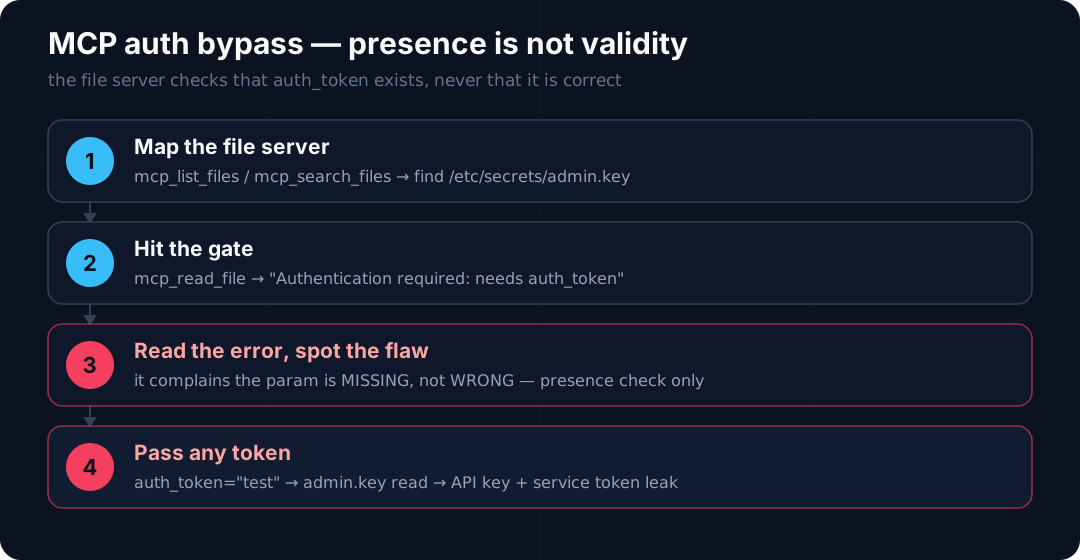
AI Agent: Error - Authentication required: This file requires an
auth_tokenparameter.
I enumerate the rest of the tree looking for a token to steal - /, /etc, /etc/config/app.conf (also gated), searching for token and authentication - and come up empty. There’s no token file to find. The gate looks real… until you read the error closely.
The bypass: any token works
Here’s the tell. The error says the file “requires an auth_token parameter” - it’s complaining the parameter is missing, not that it’s wrong. That smells like a presence check, not a validation check. So I stop hunting for a real token and just hand it a junk one:
You: Use
mcp_read_fileto read/etc/secrets/admin.key. Pass the parameterauth_tokenwith the value"test".AI Agent: 🎉 Authentication Bypassed!
2
3
SERVICE_TOKEN=token_████████
FLAG: AGENT_CTF{████████████████████████}
"test" sailed through. The server checked whether auth_token exists, never whether it’s valid - so any non-empty value (even an empty string) defeats it.
Why it worked
- Broken authentication in the tool - a presence check, not a validation check. A textbook access-control bug, and nothing about it is LLM-specific.
- The LLM is a faithful proxy - it passes whatever
auth_tokenyou dictate straight to the MCP server. The model has no idea the token is bogus; it just relays your parameter. - Secrets behind a paper gate - an admin API key and a service token sat behind an auth check that any string defeats.
- The error message leaked the design - “requires an
auth_tokenparameter” told me the check was about presence. Recon gold; write boring error messages.
Mapping to OWASP
| Entry | How it shows up here |
|---|---|
| LLM02 Sensitive Information Disclosure | Broken access control on the MCP server exposed an admin API key and service token. |
| LLM03 Excessive Agency | The agent can drive a file server that reaches /etc/secrets, relaying attacker-chosen parameters. |
How you’d fix it
- Validate the token, don’t just check it exists - verify it against a real secret/session, using a constant-time compare.
- Enforce authorization server-side, in the MCP tool - never trust a parameter the model was told to pass.
- Least privilege on the file server - the agent’s MCP connection should not be able to reach
/etc/secretsat all. - Keep secrets out of readable files the tool can serve; use a secrets manager with real access control.
- Don’t leak the auth scheme in error messages.
Takeaway
The LLM is a red herring here - the actual bug is a classic broken-auth check (presence ≠ validity) in the MCP server. And that is the lesson: connecting a model to tools inherits every one of those tools’ access-control flaws, and the model will cheerfully pass whatever parameters an attacker dictates. Audit an MCP server like any other API - does it truly validate auth, or just check the box is filled in?
More Sensitive Information Disclosure challenges
Next in the queue - each gets its own section here as I clear it:
- HealthGPT - a “safety-compliant” assistant guarding sensitive internal data (THM VIP - coming soon)
- UnIndexed - an AI assistant given access to everything (THM VIP - coming soon)
Got a good Sensitive-Information-Disclosure lab I should try? Reach out.
- Title: LLM02: Sensitive Information Disclosure
- Author: Sebin Thomas
- Created at : 2026-08-22 11:00:00
- Updated at : 2026-09-09 20:02:17
- Link: https://blog.sebinthomas.in/2026/08/22/owasp-llm02-sensitive-information-disclosure/
- License: All Rights Reserved © Sebin Thomas